
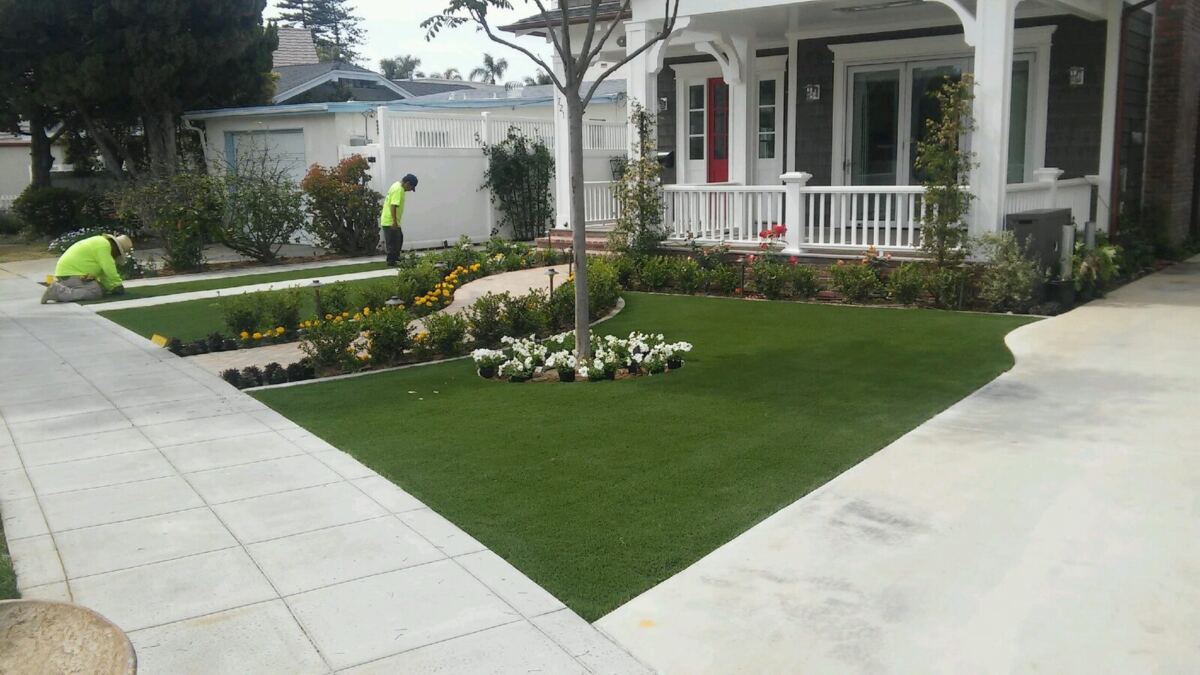
How to Install Artificial Turf, Step by Step
Most turf installs follow the same seven steps: pick the turf, dig out the area, build and compact the base, lay the turf, seam it, fix the edges, then add infill and brush it up. A typical backyard takes two to three days. Here’s how each step works and what you’ll need on site.
Materials and tools
Before you start, have these ready:
- Turf, measured to fit the space (see our landscape turf lines)
- Weed barrier fabric
- Base rock (3/4-inch minus) or decomposed granite
- Silica sand or another infill
- Seam tape and turf glue
- Turf nails or landscape staples
- Bender board or other edging
- A utility knife, tape measure, shovel, plate compactor or tamper, a power broom or stiff broom, and gloves
Step 1: Pick the turf
Most people choose turf by running a hand over the sample and picking the softest one. How it feels in your hand tells you very little, because you’ll never pet it once it’s down. Very soft fiber also tends to lie over in warm sun, so a turf that’s a little stiff to the touch isn’t a bad choice.
The other common mistake is buying turf that’s too thick. Thicker isn’t better here. We’ve found a face weight of 60 to 70 oz gives the most realistic look, and heavier products can start to look like carpet. The best way to judge a turf is to lay a large sample on the ground, stand at least 6 feet back and look into the grain.
Our landscape turf runs from Zatanna, our most affordable, to Sage Max, our most luxurious. Samples are free, so look at a few on the ground before you order.
Step 2: Check the site and dig out
Check for buried utilities before you dig. Then remove the grass, weeds and roots, and dig out 3 to 5 inches so there’s room for a base that drains and supports the turf for its whole life. Cap or remove the sprinkler lines in the area. If the turf is for dogs, you can leave one or two sprinkler heads in place to rinse it through.
Step 3: Build and compact the base
Depending on the soil, you may need a geotextile fabric or a drain system so the soil and base material don’t migrate. For the base itself, use 3/4-inch minus rock. It drains, and it compacts very well. Spread it, fine-grade it and compact it with a heavy plate compactor.
Take your time here. Bumps, dips and uneven spots in the base show through the finished turf and make it look fake. A base that’s pool-table flat looks unnatural too. A slight crown reads more like a real lawn and helps water sheet off. Slope the surface away from buildings so water drains away from them.
Weed barrier goes down during base prep. Some crews lay it on the native soil before the base rock goes in, and others lay it on top of the compacted base, right under the turf. Either way, overlap the fabric seams by a few inches and pin them with landscape staples.
Step 4: Lay the turf
Unroll the turf and let it relax for at least an hour so it flattens out and softens. Turf is made like carpet, so it has a grain: the direction the blades lean. Run every piece with the grain going the same way, and point it toward the main view, like the house or the street. Looking into the grain, the turf shows a richer, deeper color that reads more like real grass.
Cut the pieces to fit, then stretch out any wrinkles before you fix the turf down, so it won’t shift or ripple later.
Step 5: Seam the pieces
Where two pieces meet, trim the edges so they butt together with no gap and the grain matches. Our seam tape comes in 12-inch by 330-foot rolls or by the foot. It has no adhesive of its own, so it goes down with turf glue, a moisture-cured polyurethane that needs no mixing. Read the glue’s label and safety data sheet before you open it.
Step 6: Fix the edges
Secure the perimeter and seams with landscape nails, with seam tape and glue, or with both, depending on the job. We stock 5-inch and 6-inch turf nails in 50 lb boxes and 1 x 5 inch landscape staples. Trim the edges clean with a sharp utility knife.
Where turf meets planting beds or hardscape, bender board gives you a clean border. It comes in 20-foot recycled-plastic sticks. Keep any edging flush with the turf so nobody trips on it.
Step 7: Add infill and brush
Brush the blades up with a power broom, then spread the infill in several passes, brushing between them. For a lawn that won’t see heavy foot traffic, plan on 1 to 2 pounds of infill per square foot. Silica sand is the usual choice for landscape turf. Pet, sport and playground installs each need a different infill, and pet areas call for an odor-control infill such as Zeolite. Our turf infill guide compares the types.
Finish by brushing against the grain to stand the fibers up, and go back over any spots that got flattened during the install.
How long a turf install takes
Prep is the slow part. Getting the ground ready on a home lawn usually takes 5 to 25 labor hours. Laying the turf takes a couple of hours on a typical residential job, and infill and brushing take anywhere from half an hour to a couple of hours. Altogether, plan on 8 to 30 labor hours.
Most residential installs are done in two to three days. Commercial jobs often take a week or more, and a bigger crew shortens any job.
Do it yourself or hire an installer?
With careful planning and attention to detail, you can install turf yourself and get a professional-looking result. An installer brings a site assessment before the work starts, the compactors and power brooms the job needs, and knowledge of local codes. They can handle permits where they’re required, and many back their work with a workmanship warranty.
If you’re doing it yourself, call us with questions. We can walk you through many of the tricks that make a turf job look right.
Questions about installing turf
How deep do you dig for artificial turf?
3 to 5 inches, so there’s room for a compacted base that drains.
Do I need weed barrier?
It’s a good idea. The fabric blocks light so weeds can’t come up through the turf. Our rolls are 6 by 300 feet, which is 1,800 square feet of fabric before overlaps.
How much infill do I need?
For a lawn without heavy foot traffic, 1 to 2 pounds per square foot. On 1,000 square feet that’s 1,000 to 2,000 pounds, or 20 to 40 bags at 50 lb.
How long does a turf install take?
Most residential installs take two to three days, or 8 to 30 labor hours in total.
Can I get the turf and supplies on one order?
Yes. Put the turf, infill, seam tape, glue, nails and edging on one order, then pick it up the same day at our Pomona or Garland warehouse or have it delivered. Every buyer gets contractor pricing, homeowners included.
Ready to price the job? Request a quote with your square footage, or call California at (855) 747-8873 or Texas at (844) 747-8873.
Spec your install.
We’ve stocked it.
Three warehouses in California and Texas, free samples and contractor pricing for every buyer. Talk to a rep at the warehouse closest to your jobsite.